[inoqube]
Logistics Platform

FREIGHT OPERATIONS

Fifteen orders a day per logistician, up from five.

A digital logistics platform for full-truckload operators. Logisticians, carriers and drivers work in one system: every order goes out to the whole contractor base, carriers bid and sign digitally, documents generate themselves, and fuel runs on cards. Built by Inoqube and proven in production at a top-5 full-truckload carrier.

Runs on AWS or on your own servers. Integrates with your ERP, logistics marketplaces and verification services.

5 to 15
orders per logistician per day
€70 to €31
cost per order
7 to 10
carriers handled at once, from 4 or 5

The logistician's order board. Sample data, illustrative.

  • Logistician, carrier and driver modules
  • Digital signatures and e-documents
  • Fuel card management
  • ERP and marketplace integrations

WHY FIVE WAS THE CEILING

Phone and email cap what one logistician can do.

The operator wanted to double orders per logistician without hiring. Measured, the ceiling was five a day, and every reason was in the process.

  • 01

    One contractor at a time

    Coordination by phone and email: unreachable contacts, spam, call you later. No parallel work on orders.

  • 02

    Four or five carriers, at most

    That is as many as one person can keep in play, so only a few carriers ever heard about a new order.

  • 03

    Little price competition

    Logisticians defaulted to familiar carriers, and a small audience for each order kept prices high.

  • 04

    Paper and post

    Contracts and transport documents moved by email and postal mail, with data retyped at every step.

  • 05

    No cover, no visibility

    Personal relationships between logisticians and carriers meant nobody could stand in for a colleague, and delays had a million unlogged reasons.

  • 06

    Unverified counterparties

    No systematic checks on carriers, vehicles or drivers, so poor fulfilment was a live risk on every order.

THE CORE IDEA

Carriers compete for orders. The logistician decides.

Before the platform, one logistician carried seven kinds of work per order and the carrier did one. The platform takes over collection, broadcasting, document generation and the ERP link; the carrier prepares their own paperwork; the logistician is left with the decision.

Before

Logistician

7 activities
  • Collects orders into a database
  • Broadcasts the order list
  • Chooses the best tender
  • Prepares data for documents
  • Generates preliminary documents
  • Generates final documents
  • Links to the ERP

Carrier

1 activity
  • Carries out the transport

After

Logistician

1 to 2 activities
  • Chooses and approves the best tender
  • Reviews the data

Platform

automated
  • Collects orders
  • Broadcasts to every carrier
  • Generates preliminary and final documents
  • Links to the ERP

Carrier

2 activities
  • Prepares their own document data
  • Carries out the transport

THREE MODULES

One system, three roles.

01

Logistician's space

The control room for orders: distribute them between your own fleet and contractors, with full tracking and documents.

  • Work any open order or focus on priorities
  • Hints on each order: similar history, price dynamics, drivers who ran the route
  • Nearest available trucks to the loading point
  • Automatic truck and carrier suggestions from the order requirements
  • Contract terms agreed and signed digitally
  • Order tracking and electronic document exchange
02

Carrier's space

A portal where contractors take part in the marketplace instead of waiting for a call.

  • Browse and respond to new orders
  • Propose price and conditions
  • Sign contracts and documents digitally
  • Combine several orders into one route
  • Payment schedules, transport documents and claims in one place
  • Extra services, technical assistance discounts, fuel refund agreements
03

Security space

Access control and verification for everyone on the platform.

  • Users and roles with granular access
  • Counterparty documents and legal status checked, including licence validity
  • Vehicles checked against stop-lists and police databases
  • Drivers approved or denied per contract
  • A rating system that surfaces reliable counterparties

ON THE ROAD

A driver app and a fuel system, built to the same design.

Driver mobile app

A cross-platform app built in Flutter, kept to the driver's own route and nothing else.

  • Assigned trips, viewed and worked through in one list
  • Step-by-step guidance so departure and arrival paperwork is complete
  • Route checkpoints with the required actions in the app, on a map
  • Digital document transfer straight into the platform
  • A built-in knowledge base and an in-app support channel

Fuel card management

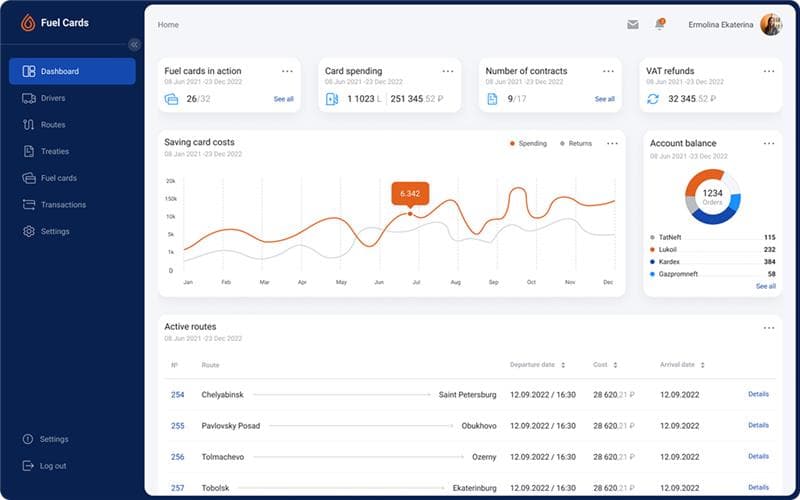
Fuel is a large share of transport cost, and most carriers run on simplified taxation. Issuing fuel cards instead of paying fuel inside carrier rates lets the operator reclaim VAT on fuel. The system makes that routine.

  • Fuel company APIs connected, balances managed centrally
  • Physical and virtual cards issued or revoked in two clicks; virtual cards appear on the driver's phone instantly
  • Limits per fuel type and geographic restrictions on use
  • Carrier self-service: balance and transactions from any device
  • Fuel accounted per voyage, with closing documents for tax
  • Per-trip fuel records fed into accounting
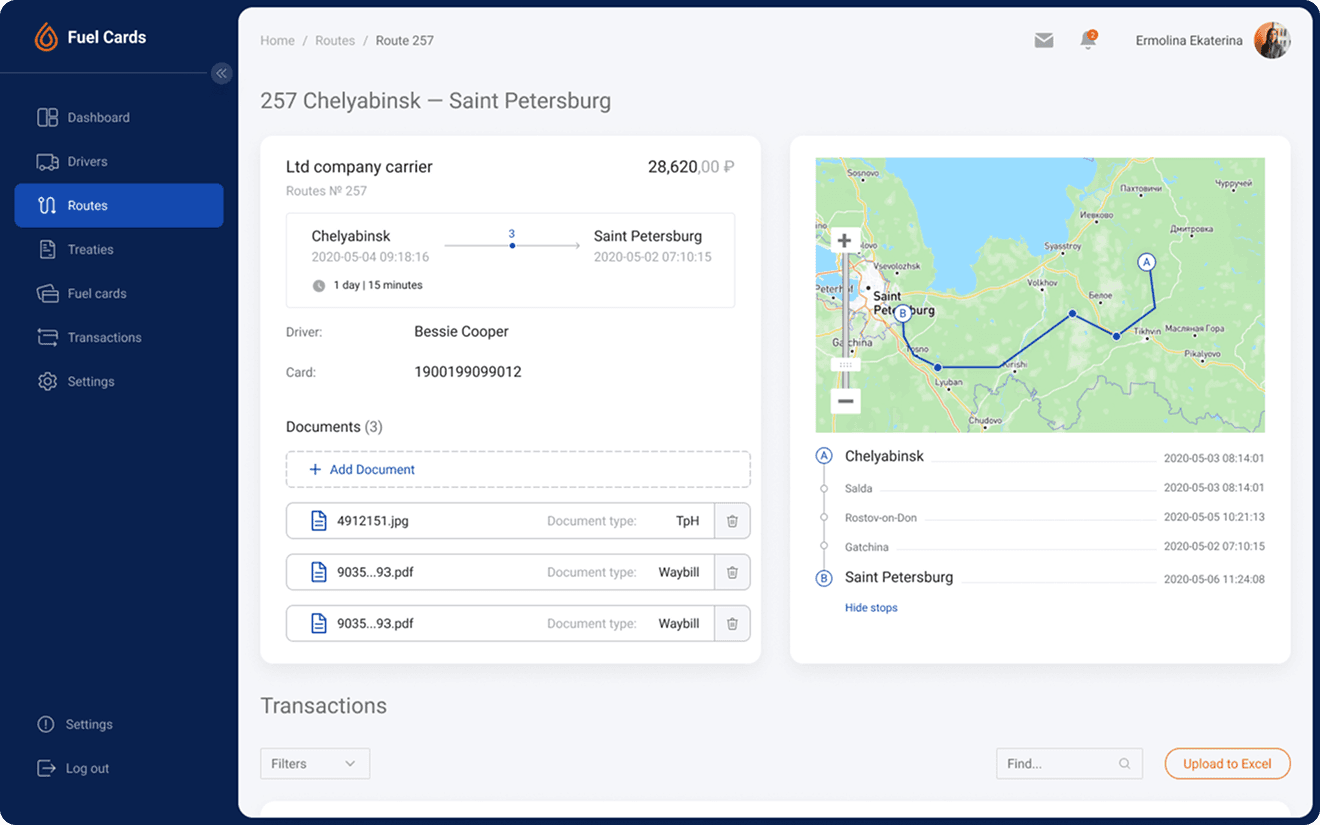
The fuel card system showing route 257 with the carrier, driver, card, attached documents and every stop on a map
One route in the fuel card system: carrier, driver, card, documents and every stop with a timestamp.
Fuel card dashboard with cards in action, card spending, number of contracts, VAT refunds, account balance and active routes
The dashboard: cards in action, spending, contracts and VAT refunds at a glance.

UNDER THE HOOD

Modernised while it kept running.

The existing platform had grown feature by feature on legacy interfaces, with cookie authentication unsuited to mobile, queries running far slower than they should and a monolith that could only scale as a whole. We fixed the foundations alongside the new modules.

  • Design system

    One set of rules for menus, navigation, tables and forms. Tables became the main work tool, with cell types per data format and a clear hierarchy, so a page shows far more without getting longer.

  • Token-based authentication

    Cookie sessions replaced with tokens that work for the mobile app and microservices, remove CORS problems and allow authorisation policies finer than roles.

  • Database optimisation

    Nearly every query was running orders of magnitude slower than necessary. Optimised, with response times to match.

  • Microservices

    Domain services such as Trips and Notifications extracted from the monolith, so each scales on its own load.

  • Personal data compliance

    Data split into personal and anonymised sets: personal data on compliant domestic infrastructure, the rest free to sit on international servers.

  • Integrations

    Logistics marketplaces, corporate ERPs, counterparty verification services and geo-distance tools, connected as part of the build.

MEASURED RESULTS

Three times the orders per logistician. Less than half the cost per order.

Reference deployment

A top-5 full-truckload carrier

47 branch offices across 8 regions, its own fleet, and framework agreements with federal retail chains and multinational manufacturers. Orders arrive irregularly by ERP, phone and email.

Measured against the original KPI: orders per logistician per day

IndicatorBeforeAfter
Logistics employees240110
Total monthly salary€398,000€174,000
Orders per day per logistician515
Total orders per day1,2001,650
Cost per order€70€31
  • Orders per logistician per day up threefold, from 5 to 15
  • Cost per order down 56%, from €70 to €31
  • Logistics headcount down 54% while total throughput rose 37%
  • €224,000 a month less in salary
  • Each logistician handles 7 to 10 carriers at once, up from 4 or 5
  • Every delay and every KPI logged automatically
  • A growing carrier base with real price competition

HOW WE IMPLEMENT IT

Five stages, none of them disruptive.

Each stage starts with an agreed scope and target result, timed so your core operation and the people running it are never blocked.

  1. 01

    Research

    We study your processes, tools and constraints and deliver an analytical note with the current workflow and KPIs, a technical specification for the platform configuration, and UI prototypes with justified user cases.

  2. 02

    Server setup

    Three environments: development for engineering, test for your review, production for go-live. On AWS or your own corporate servers.

  3. 03

    Module development

    Configuration, refinements and integrations with your existing IT systems, tracked on a Gantt plan with named specialists and deadlines. You see task status in Jira throughout.

  4. 04

    Staff training

    Training for every role, with feature walkthroughs and materials your future recruits can use.

  5. 05

    Support

    Ongoing support for questions and issues, plus new modules or changes as your processes evolve.

Technology

C# / .NET CoreReactFlutterPostgreSQLODataAWS or private servers

QUESTIONS

What people ask first.

Both. The platform exists and runs in production: the three modules, the driver app and the fuel card system. Stage one of every implementation maps your workflow and configures the platform to it, and integrations with your systems are built as part of the rollout.

At the reference deployment they did, because the platform gives them something: orders they would never have heard about, digital signing instead of paperwork, payment schedules and claims in one place, and fuel cards. The carrier base grew after launch.

Yes. The reference deployment integrates with corporate ERPs, logistics marketplaces, counterparty verification services and geo-distance tools. Customers can submit orders from their own systems, and trip status flows back to them.

On AWS, or on your own corporate servers. Personal data can be kept on compliant domestic infrastructure while anonymised data sits elsewhere.

It depends on the integrations and the number of branches. The five stages run in sequence, and we agree the timetable for each up front so your operation is never blocked. Bring your order volumes and we will give you a plan.

Per implementation, scoped after the research stage. Configuration, integrations and support differ per operator, so there is no price list.

SEE IT ON YOUR OWN ORDER FLOW

Book a platform demo.

Bring a week of orders and the carriers you work with. We show how the same orders would run on the platform, and what it would take to get there.

WHAT COMES WITH IT

  • Rollout led by a PrincipalScope, pilot and go-live owned by one senior engineer, working with your compliance, legal and IT leads.
  • Integration with your systemsSharePoint, ERPs, document stores, identity. We build the connections the product does not ship with.
  • Support after go-liveConfiguration, policy tuning and new use cases handled by people who know your setup, in your time zone.